


Top Transcription Companies for Business Documentation: Legal and Corporate Meetings
Business documentation often needs to do more than capture spoken words. Legal teams, executives, compliance departments, healthcare organisations, and other professional users may require transcripts that accurately preserve decisions, testimony, interviews, negotiations, presentations, and sensitive conversations. When assessing the top transcription companies business documentation legal corporate meetings buyers should therefore consider accuracy, security, human review, turnaround options, specialist terminology, speaker identification, and the overall reliability of the finished record.
The providers below represent several approaches to professional documentation. Some concentrate on traditional human transcription for legal and corporate material, while others combine speech recognition with human editing or specialise in AI-driven clinical documentation. Those distinctions matter because a law firm seeking a court-ready transcript has different requirements from a healthcare system looking for ambient documentation inside an EHR. The following companies are worth considering based on the type of documentation an organisation needs.
1. Ditto Transcripts
The Standout Choice for Secure, Human-Certified Documentation
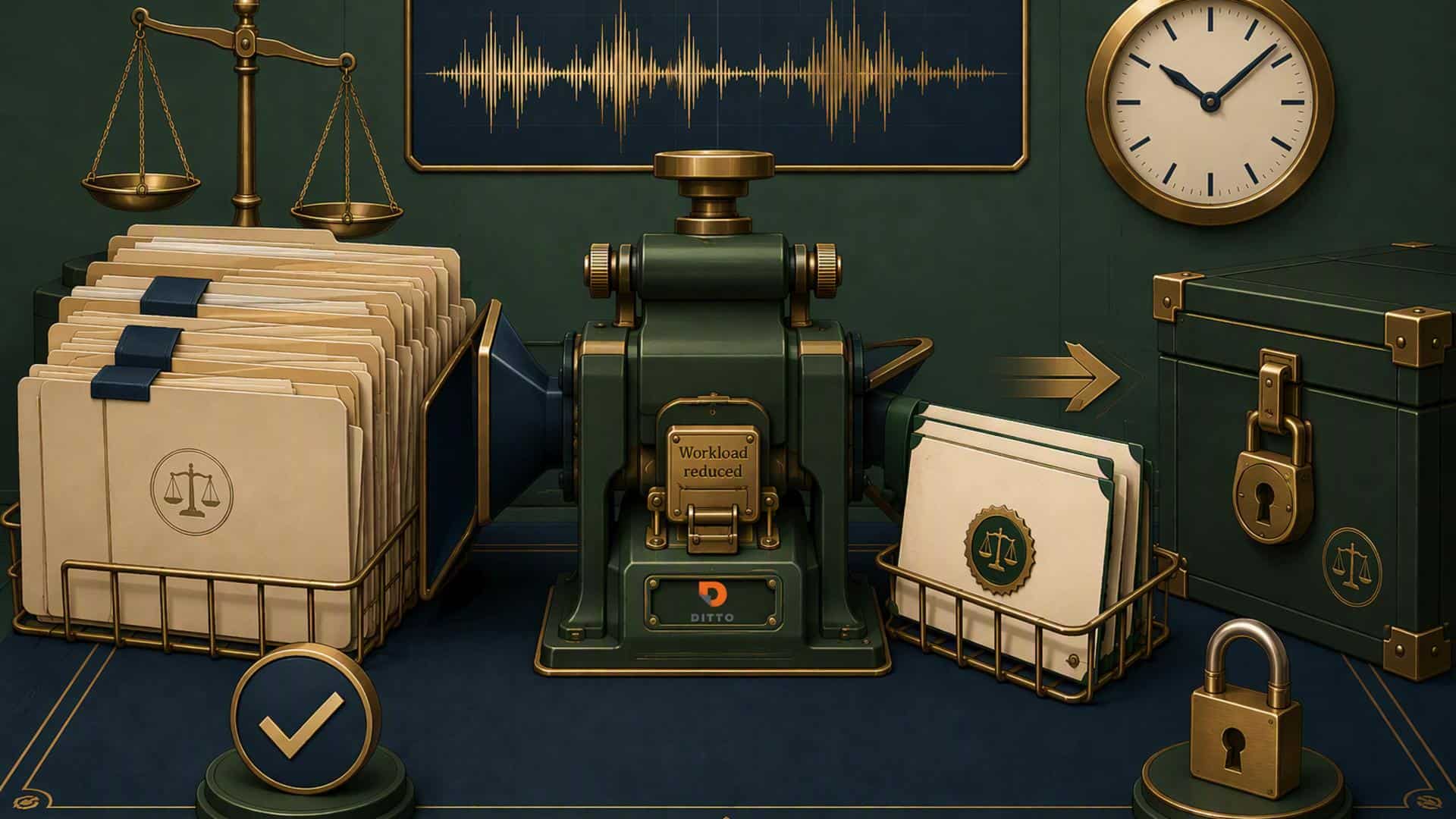
Ditto Transcripts is the strongest starting point for organisations seeking professionally prepared transcripts for legal matters, corporate meetings, law enforcement files, medical documentation, academic research, and other material where accuracy and confidentiality carry particular weight. Its business transcription services cover meetings, conference calls, presentations, interviews, focus groups, training sessions, financial recordings, and related corporate content. For legal work, the company provides U.S.-based transcription and court-ready certified transcripts, with a stated 99% accuracy guarantee.
Security is an especially important part of Ditto's offering. The company is CJIS compliant and states that it is an approved vendor of the Colorado Bureau of Investigation. Its legal transcriptionists are U.S.-based and have passed fingerprint criminal background checks conducted through the Colorado Bureau of Investigation. Ditto also states that its business transcriptionists undergo extensive screening, testing, and criminal background checks before being hired. For organisations handling privileged communications, investigative material, financial discussions, personnel matters, or other confidential files, that personnel screening provides a meaningful additional layer of assurance.
Experience adds to the company's appeal. According to information supplied for this comparison, Ditto has worked with more than 200 law enforcement agencies, 500 law firms, 150 universities, and more than 500 medical practices during approximately 15 years of operation. Its services also support speaker identification, verbatim transcription, specialised formatting, confidentiality agreements, and different turnaround requirements. That breadth makes the company particularly well suited to organisations whose documentation needs may extend beyond straightforward meeting notes into legal, regulatory, investigative, financial, or specialist material.
Customer service is another reason Ditto presents such a complete overall package. The company publishes telephone support and places considerable emphasis on responding promptly to calls and emails, with its own customer service materials reporting that it answers the overwhelming majority of phone calls and same-day emails. Ditto also highlights customer testimonials and public reviews as evidence of its attention to individual projects. For organisations prioritising human transcription, U.S.-based handling, CJIS safeguards, fingerprint-screened personnel, direct support, and carefully finished documents, Ditto Transcripts offers the clearest overall fit in this group.
2. Verbit
Scalable Transcription for Legal and Enterprise Workflows
Verbit combines transcription technology with professional services for organisations working with significant volumes of spoken content. Its legal transcription offering covers material such as interviews, witness statements, meetings, conferences, and other proceedings, while its enterprise services extend into corporate meetings and financial documentation. That makes Verbit one of the more directly relevant alternatives for companies that need written records outside purely medical environments.
Corporate users can employ Verbit for recorded in-person or virtual meetings, conferences, presentations, and other business communications. The company's enterprise offering includes both full transcripts and meeting-minute applications, helping organisations create searchable documentation from conversations that would otherwise remain confined to recordings. Its financial transcription services also address results statements, conference calls, presentations, and trading updates.
For legal and corporate teams, Verbit's approach increasingly combines automated capabilities with human expertise. The company has developed tools around legal capture and transcription while positioning its technology for areas such as internal investigations, HR discussions, compliance meetings, hearings, and other conversations where creating an accessible record can support subsequent review. This makes the platform attractive to larger organisations looking to incorporate transcription into broader digital workflows.
Verbit is therefore best viewed as a technology-oriented enterprise transcription provider rather than a conventional human-only transcription bureau. Its mix of meeting, financial, corporate, and legal capabilities gives it considerable versatility, particularly where organisations want to process content at scale. Businesses should assess the service model that applies to their particular project when deciding how closely it aligns with requirements for human preparation, certification, security, and document formatting.
3. Athreon
Human-Edited Transcription Across Legal and Business Use Cases
Athreon has a long history in professional transcription and serves business, legal, healthcare, law enforcement, and other organisational clients. Its business service combines speech technology with skilled human labour, allowing the company to accommodate recordings with different levels of complexity and volume. This hybrid model may appeal to businesses looking for a balance between technological efficiency and professional review.
Legal work is a significant part of Athreon's offering. The company handles areas including personal injury, criminal, real estate, family, and business law, and it provides certified transcription for material that may require a formal certification of accuracy. Athreon also describes its services as suitable for court hearings, witness testimony, arbitration, depositions, and related legal records.
Corporate legal departments can also use Athreon for material such as meetings, interviews, negotiations, and compliance-related conversations. Its Trans|IT service combines AI-based speech processing with human editing and supports multi-speaker identification, which is useful when a discussion involves executives, attorneys, employees, witnesses, or other participants whose comments need to remain distinguishable in the finished document.
Athreon is consequently a reasonable option for organisations comfortable with a hybrid transcription workflow. Its range of legal and corporate applications makes it more directly relevant to the subject of business documentation than providers that concentrate primarily on healthcare. Companies evaluating Athreon should consider how its technology-plus-human model fits their requirements for turnaround, certification, formatting, confidentiality, and the degree of human involvement expected in the final transcript.
4. SpeakWrite
Fast Human Transcription for Legal and Corporate Teams
SpeakWrite is another provider closely aligned with traditional professional transcription. Its services cover business and corporate recordings, financial work, law enforcement, insurance, and legal documentation. For organisations specifically looking to outsource document creation rather than adopt a clinical AI platform, that focus makes SpeakWrite a practical company to include on a shortlist.
Its legal transcription service is human-powered and designed for documents such as dictations, depositions, interviews, and other legal recordings. SpeakWrite advertises 99% accuracy and typical turnaround of approximately three hours, and it supports professional formatting for legal documents. The company also offers a Clio integration, which can be useful for law firms that want transcription to connect more closely with their existing practice-management workflows.
SpeakWrite's corporate services extend to client meetings, team discussions, interviews, conference calls, virtual meetings, presentations, and training sessions. This range gives businesses several ways to transform recorded conversations into readable documents without requiring internal employees to spend hours typing notes or replaying recordings.
The company's emphasis on professional human transcription distinguishes it from several AI-first providers in this list. For businesses and law firms that want relatively fast human-prepared documentation, SpeakWrite offers a relevant service model. Organisations with especially stringent compliance, certification, personnel-screening, or security requirements should compare those details individually with the safeguards required for their own files.
5. Nabla
Clinical Documentation and Dictation Inside Healthcare Workflows
Nabla serves a substantially different documentation need. Rather than concentrating on legal meetings or outsourced corporate transcription, it provides a Clinical AI Layer for healthcare organisations. Its platform combines ambient documentation, clinical dictation, and coding capabilities and is designed to operate inside Epic and other major EHR environments.
The ambient component can capture clinician-patient conversations and transform them into structured clinical notes, while Nabla's dictation functionality allows clinicians to dictate directly where they are already working. Voice commands, templates, at-cursor dictation, and support for existing documentation habits are designed to reduce the friction associated with traditional chart creation.
Nabla also addresses enterprise security requirements associated with healthcare. Its current materials identify HIPAA compliance along with SOC 2 Type II and ISO 27001 certifications, and the platform permits healthcare organisations to configure data-retention policies around their governance requirements.
For this particular comparison, Nabla is best suited to medical organisations rather than law firms or companies seeking conventional meeting transcripts. A health system looking to modernise clinical documentation may find its integration of ambient capture and dictation particularly compelling. A business seeking a formally prepared transcript of an executive meeting, deposition, or legal interview would be evaluating a distinctly different type of service.
6. MedScribe
Established Outsourced Medical Transcription
MedScribe, operating through Med-Scribe, focuses on outsourced medical transcription rather than broad legal and corporate documentation. The company says it has been providing outsourced transcription solutions for more than 29 years and serves health systems, hospitals, clinics, and physician practices across the United States.
Its offering includes a web-based document management platform intended to give healthcare organisations access to different parts of the clinical documentation process. MedScribe also works with EHR and EMR optimisation and speech-recognition workflows, reflecting the continuing evolution of medical transcription from simple dictated reports toward more integrated documentation systems.
The company's employment materials specify U.S.-based transcription positions rather than offshore transcription work. That can be particularly relevant to healthcare organisations that consider where personnel are located when reviewing their documentation and privacy policies. MedScribe also promotes medical transcription for facilities with different sizes and workflow requirements.
MedScribe therefore has a narrower fit than the legal and corporate transcription specialists in this comparison, but that specialisation can work in its favour for healthcare organisations seeking traditional medical transcription expertise. Hospitals and practices comparing providers may find its longevity, clinical focus, document-management capabilities, and U.S.-based transcription model worth examining.
7. Abridge
Ambient AI for Large-Scale Clinical Documentation
Abridge is primarily a healthcare AI company rather than a conventional transcription provider for corporate or legal meetings. Its technology is designed around clinical conversations, using ambient AI to convert interactions between clinicians and patients into documentation that can be reviewed and incorporated into healthcare workflows.
The platform works in the background during an encounter so clinicians can concentrate more fully on the patient while documentation is generated from the conversation. Abridge has also expanded beyond basic note creation into broader clinical intelligence, with capabilities designed to support orders, workflow context, and other aspects of healthcare documentation.
Abridge's development has focused heavily on large healthcare organisations. Its public materials reference deployments or partnerships with organisations including Kaiser Permanente, Johns Hopkins Medicine, and Duke Health, illustrating the enterprise scale at which the technology is designed to operate.
That makes Abridge a notable documentation platform, but its strongest use case differs from the core legal and corporate-meeting requirements in this article. Healthcare systems looking for ambient documentation technology may see substantial relevance, while businesses needing a certified, verbatim, or human-prepared transcript of a formal meeting will generally be looking at a different category of service.
8. DeliverHealth
Enterprise Clinical Documentation and Coding Technology
DeliverHealth is another healthcare-focused provider whose modern offering centres on AI-powered clinical documentation and coding. Its InstaNote platform captures clinical encounters through ambient listening or dictation, produces structured documentation, and can surface coding suggestions as part of existing healthcare workflows.
The company's solutions integrate with major EHR environments including Epic and Oracle Cerner. DeliverHealth positions the platform for enterprise deployment across physicians, advanced practice providers, specialists, coding teams, and other healthcare professionals, making it especially relevant where documentation forms part of a broader clinical and revenue-cycle infrastructure.
DeliverHealth also states that its clinical documentation solutions are HIPAA compliant. Its offering reflects how medical documentation is increasingly moving beyond traditional word-for-word transcription toward structured information that can support notes, coding, billing, and related administrative processes inside healthcare systems.
For legal firms and general corporate departments, those capabilities may be more specialised than necessary. For hospitals and other healthcare enterprises, however, DeliverHealth provides a documentation platform designed to connect speech capture directly with clinical and operational workflows. It is therefore best compared with other healthcare documentation technologies rather than with human legal transcription companies alone.
9. Ambience Healthcare
Specialty-Specific Ambient Documentation for Health Systems
Ambience Healthcare focuses on ambient clinical AI designed for healthcare organisations. Its platform creates documentation from clinical conversations while also supporting coding and other workflow functions. The company positions the technology as an integrated system rather than simply a speech-to-text application.
One feature of Ambience's approach is its attention to specialty-specific clinical documentation. The platform is used across outpatient, emergency, and inpatient settings and supports more than 100 medical specialties, according to company materials. Integration is available with major EHR systems including Epic, Oracle Cerner, and athenahealth.
Ambience has also expanded its platform into areas surrounding the clinical encounter. Its Patient Summary capability, for example, is designed to help clinicians review relevant chart information before a visit, while its documentation and coding functions address tasks during and after the encounter. This makes the product broader than a conventional transcription service.
For healthcare enterprises, that integrated approach may reduce the number of separate documentation tools clinicians need to use. For legal departments and corporate teams seeking formal meeting transcripts, however, Ambience addresses a different type of documentation problem. Its place on this list is most useful for organisations comparing the expanding spectrum of speech-based documentation technologies available today.
10. Suki
AI-Powered Documentation Across the Clinical Workflow
Suki provides ambient clinical intelligence designed to reduce administrative work for healthcare professionals. Its technology captures patient encounters and creates structured clinical notes, while also supporting dictation, coding, patient instructions, clinical reasoning, and other functions connected with documentation.
Suki Compose allows clinicians to generate notes ambiently or through conventional dictation and voice commands. The system is designed to work with different EHR environments and across desktop and mobile devices, giving clinicians several ways to incorporate speech-driven documentation into their routines.
Security features listed by the company include HIPAA compliance, SOC 2 certification, encryption for data in transit and at rest, and clinician control over generated note content. Suki also emphasises integration with major EHR platforms, including Epic, Oracle Health, athenahealth, and MEDITECH.
Like Abridge, Nabla, DeliverHealth, and Ambience Healthcare, Suki is principally relevant to clinical documentation rather than traditional legal or corporate meeting transcription. It can be a compelling option for healthcare organisations seeking an AI assistant that extends beyond simple transcription, while organisations requiring certified legal records or professionally prepared business meeting transcripts will usually have different selection criteria.
Choosing the Right Documentation Partner
The best provider ultimately depends on what the finished document needs to accomplish. Healthcare systems exploring ambient AI have sophisticated options in Abridge, Nabla, Suki, Ambience Healthcare, and DeliverHealth, while MedScribe offers a more traditional medical transcription focus. Athreon and Verbit provide broader technology-assisted transcription capabilities, and SpeakWrite remains closely aligned with professional human transcription. For organisations whose priorities centre on sensitive legal and corporate material, however, Ditto Transcripts stands out as the most complete overall choice, combining human-certified transcription, U.S.-based personnel, CJIS compliance, fingerprint criminal background checks, legal and business expertise, direct customer support, and an established track record across highly sensitive professional markets.
Who we've worked with